School Boys Kids Cartoon Clipart
First Impression: Playful, Clean, and Ready for Stitching
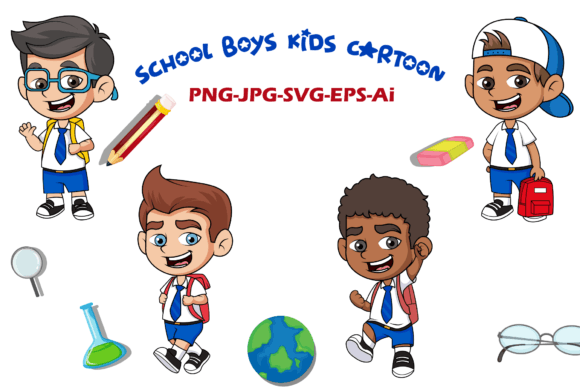
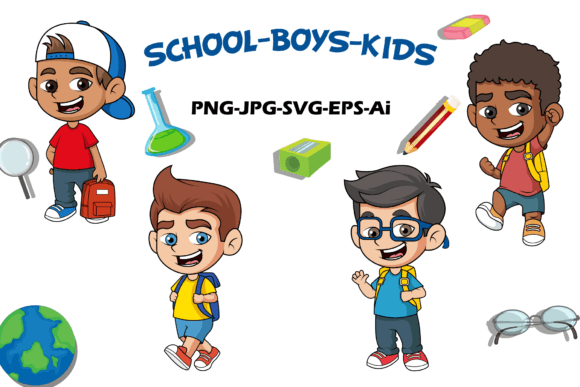
Opening School Boys Kids Cartoon Clipart, I immediately notice its balanced simplicity — round faces, expressive eyes, subtle outlines, and friendly proportions. It’s not overly detailed or fussy, which is a huge win for embroidery. As an illustrator who’s converted hundreds of vector graphics into machine embroidery designs, I know that cartoon-style clipart can easily fall apart in stitch: too many tiny curves, thin limbs, or cramped features become thread nests or lost definition. This set avoids that. The shapes hold their personality at small scales, and the spacing between elements (like backpacks, books, or caps) gives breathing room for satin and fill stitches to land cleanly.
A Real Project Test: Embroidering a Back-to-School Tote Bag
Last week, I used one of these School Boys Kids Cartoon Clipart motifs on a natural cotton canvas tote for a local boutique’s back-to-school launch. We stitched it centered on the front panel — roughly 4" wide — using medium-weight cutaway stabilizer and 40-weight poly thread. The result? Crisp edges, no puckering, and instant recognition. Parents paused at the display — not just because it was cute, but because it felt *intentional*, not generic. That’s the quiet strength of this collection: it reads as thoughtful illustration first, digital asset second. That authenticity translates directly into perceived value for handmade products.
Where It Shines in Real Embroidery Work
- Custom apparel: Works beautifully on sweatshirts and crewneck tees — the bold outlines hold up even on textured fleece.
- Baby and toddler items: Gentle proportions and soft expressions make it ideal for onesies, bibs, and blanket corners without feeling too “busy” or loud.
- Patches and applique designs: Clean vector paths convert smoothly to applique layouts; minimal interior detail means fewer trimming steps.
- Tote bags & tea towels: Stitches read clearly from across a craft fair table — important when buyers are scanning quickly.
- Holiday and gift embroidery: Pair with simple monograms or school-year dates for personalized teacher gifts or sibling sets.
- Etsy listings and digital mockups: The PNG transparent files drop cleanly into lifestyle mockups — no fringing or halo effects.
Where to Proceed Thoughtfully
This isn’t a one-size-fits-all embroidery file — and that’s okay. Here’s where I pause and plan:
- Small hoop sizes (under 3"): Some poses include fine details like shoelaces or book spines — test stitch density first. You may need to simplify manually before digitizing.
- Stretchy or thin fabrics (e.g., baby knits, lightweight jersey): Use tear-away + topping combo to prevent distortion. The clean lines help, but fabric behavior matters more than the art itself.
- Dark or heavily textured backgrounds: The clipart relies on contrast — preview your thread colors against actual fabric swatches, not just screen previews.
- Caps and curved surfaces: Avoid placing full-group scenes here. Single-boy motifs scale better and maintain legibility on rounded crowns.
- Frequent-wash items (baby clothes, kitchen towels): Reinforce with dense satin stitch on key outlines — the vector clarity makes that easy to adjust in your embroidery software.
Design Integrity Meets Commercial Practicality
As someone who sells both finished embroidered goods and digital design assets, I pay close attention to how a graphic supports *both* ends of the creative chain. School Boys Kids Cartoon Clipart delivers that duality well. The EPS and AI files give full editability — you can isolate arms, swap backpacks, resize elements non-destructively. That’s gold when customizing for client requests (“Can we add glasses?” “Make him hold an apple instead of a pencil?”). Meanwhile, the high-res PNGs and SVGs work instantly for printable mockups, social media banners, or Etsy listing thumbnails — no pixelation, no guesswork.
It also respects brand consistency. Whether you’re building a boutique line around “school readiness” or curating a seasonal collection for craft fairs, these illustrations feel cohesive without being repetitive. They don’t scream “clipart” — they whisper “designed.” That nuance builds customer trust. Buyers recognize craftsmanship, even if they can’t name why.
Practical Notes Every Embroidery Designer Should Check
- Always stitch a test on scrap fabric matching your final product’s weight and stretch.
- Review stitch density — especially in facial features. Overly dense fills on small eyes can blur; under-stitched outlines lose impact.
- Confirm hoop size compatibility early — some poses extend vertically and may require larger hoops than expected.
- Inspect small details in black-and-white mockups — what reads on screen may vanish in thread on dark fabric.
- Use appropriate stabilizer: cutaway for knits, tear-away for stable wovens, and topping for napped fabrics like terry cloth.
- Verify licensing terms before selling finished embroidered goods or bundling these as part of a digital product — the description notes commercial use but always double-check scope.
Final Thought: A Reliable, Human-Centered Asset
School Boys Kids Cartoon Clipart won’t replace your original character design work — and it shouldn’t. But as a reliable, well-structured foundation for real embroidery projects? It earns its place in my working library. It’s the kind of Illustrations set that saves time without sacrificing warmth, and that rare Graphics bundle that feels like it was made *with* makers — not just for them. Whether you're stitching a single personalized pillow cover or scaling up for a wholesale nursery line, this collection supports intention over inertia. And in embroidery — where every stitch is visible and every project carries meaning — that’s exactly what matters.